publications
publications by categories in reversed chronological order. if you cannot find the full text online, please email me and I will be happy to provide you with a copy.
2025
-
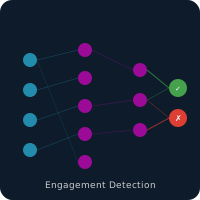 Deep Learning Approaches for User Engagement Detection in Human-Robot Interaction: A Scoping ReviewInternational Journal of Human–Computer Interaction, 2025
 -
-
 Exploring task and social engagement in companion social robots: a comparative analysis of feedback typesAdvanced Robotics, 2025
2024
-
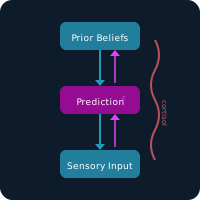 Surprise! Using Physiological Stress for Allostatic Regulation Under the Active Inference Framework2024Preprint. Published as conference paper at ACII 2024. Nominated for Best Paper Award
 -
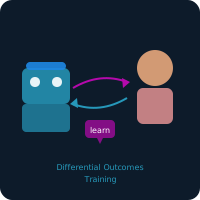 Human-Robot Mutual Learning through Affective-Linguistic Interaction and Differential Outcomes Training2024Preprint. Published as conference paper at ACIIW 2024
 -
 DigiDOP: A Framework for Applying Digital Technology to the Differential Outcomes Procedure (DOP) for Cognitive Interventions in Persons with Neurocognitive DisordersNeuroscience & Biobehavioral Reviews, 2024
 - Surprise! Using Physiological Stress for Allostatic Regulation Under the Active Inference FrameworkIn 2024 12th International Conference on Affective Computing and Intelligent Interaction (ACII), 2024
- Human-Robot Mutual Learning Through Affective-Linguistic Interaction and Differential Outcomes TrainingIn 2024 12th International Conference on Affective Computing and Intelligent Interaction Workshops and Demos (ACIIW), 2024
-
 Operationalising Social Bonding in Human-Robot Dyads Through Physiological and Biobehavioural Proxies of OxytocinIn 2024 12th International Conference on Affective Computing and Intelligent Interaction (ACII), 2024
2023
- Operationalising Social Bonding in Human-Robot Dyads Through Physiological and Biobehavioural Proxies of Oxytocin2023Preprint. Published as conference paper at ACII 2024
- Differential outcomes training of visuospatial memory: a gamified approach using a socially assistive robotInternational Journal of Social Robotics, 2023
2022
-
 The Long-Term Efficacy of “Social Buffering” in Artificial Social Agents: Contextual Affective Perception MattersFrontiers in Robotics and AI, 2022
 -
 A Participatory Complex Systems Modelling Approach Towards Rewilding in the UKIn ALIFE 2022: The 2022 Conference on Artificial Life, 2022
2021
- Adaptation-by-proxy: Contagion effect of social buffering in an artificial societyIn ALIFE 2021: The 2021 Conference on Artificial Life, 2021
- Modeling Affect-Based Relationships and Social Allostasis as Mechanisms for Adaptation in Social GroupsUniversity of Hertfordshire, 2021
2020
- Modelling the Social Buffering Hypothesis in an Artificial Life EnvironmentIn ALIFE 2020: The 2020 Conference on Artificial Life, 2020
2019
- The Effects of Affective Social Bonds on the Interactions and Survival of Simulated AgentsIn 2019 8th International Conference on Affective Computing and Intelligent Interaction Workshops and Demos (ACIIW), 2019
2018
-
 Adaptation and the social salience hypothesis of oxytocin: Early experiments in a simulated agent environmentIn Proceedings of the 2nd Symposium on Social Interactions in Complex Intelligent Systems (SICIS), Liverpool, UK, 2018
 - Modelling adaptation through social allostasis: Modulating the effects of social touch with oxytocin in embodied agentsMultimodal Technologies and Interaction, 2018
2012
-
 Analysis of the Performance of Eigenfaces Technique in Recognizing Non-Caucasian FacesInternational Journal of Computer Vision and Image Processing (IJCVIP), 2012